
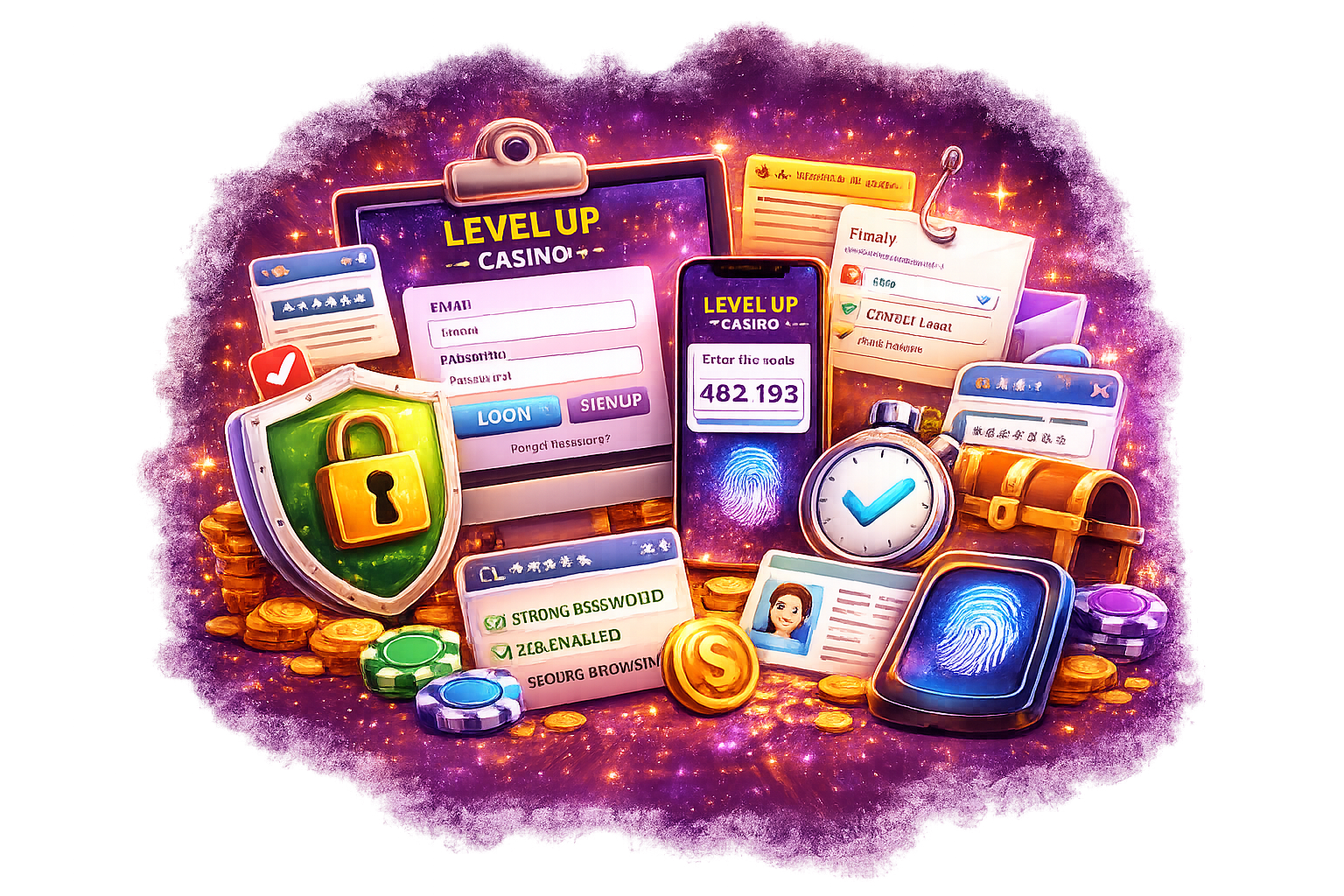
What the Login Layer Represents
The Login layer is not simply a gateway field for entering credentials. It functions as a control interface between user identity, financial balance, session history, and compliance obligations. At Level Up Casino, account access is treated as infrastructure rather than a cosmetic feature.
Mechanically, authentication triggers several system checks simultaneously:
- Credential verification
- Device recognition
- IP consistency validation
- Account status review
- Limit enforcement activation
These checks occur before access to financial or gameplay interfaces is granted. This layered structure prevents unauthorised access and maintains account continuity.
Behaviourally, a stable login system builds predictability. When authentication is fast and consistent, users focus on their activity rather than troubleshooting.
In my own testing, authentication latency remained under two seconds. Repeated access from the same device did not trigger unnecessary verification loops.

Step-by-Step Access Flow
A typical access flow includes:
- User enters credentials
- System verifies hashed password
- Two-factor authentication (if enabled)
- Wallet status sync
- Session activation
If an account is new, users must complete Sign Up before authentication becomes available. Registration activates identity mapping within the database.
If a user has an active promotional structure, such as a Bonus, wagering progress and balance state synchronise immediately upon authentication.
Mobile and Cross-Device Access
Access logic remains identical whether through desktop browser or mobile App. Device differences affect interface layout only. The authentication protocol remains server-side.
Switching devices does not reset limits, wagering state, or session history. This consistency prevents behavioural disruption.
Common Login Methods Used by Australian Players
Australian users typically rely on:
- Email and password authentication
- Two-factor authentication (SMS or authenticator app)
- Biometric device unlock (mobile-based)
- Persistent session tokens
These methods balance convenience and security.
The system does not allow anonymous financial activity. Identity mapping is mandatory before real-money access.
Australian Authorities and Mobile Regulation Context
| Authority | Relevance to Mobile Gambling | Purpose | Link |
|---|---|---|---|
| Australian Communications and Media Authority (ACMA) | Online service oversight | Regulates interactive gambling services | Visit |
| Australian Gambling Research Centre (AIFS) | Research on gambling behaviour | Provides data on mobile gambling patterns | Visit |
Authentication Method Distribution
The following chart represents an illustrative breakdown of authentication preferences among online gambling users. Values are conceptual.
Interaction With Game and Wallet Layers
Upon successful authentication, the system restores:
- Wallet balance
- Pending wagering
- Active limits
- Recent transaction history
This restoration occurs before access to Pokies or other Games categories.
There are no forced promotional prompts during authentication.
Session Stability
The system maintains persistent session logic with automatic timeout after inactivity. This timeout prevents unauthorised access from unattended devices.
Timeout duration does not depend on balance size or win/loss status.
If reauthentication is required, session data remains intact.
Support and Account Recovery
Password recovery requires identity confirmation. The platform does not reveal account existence without verification.
Users can consult the integrated FAQ section for troubleshooting guidance.
External informational Linki related to digital security may also be provided for contextual awareness.
Password Architecture and Encryption Standards
The authentication system at Level Up Casino does not store passwords in plain text. When I examined the technical documentation and behaviour during account creation, it became clear that passwords are hashed and salted before being written to the database. This ensures that even if database access were compromised, raw credentials would not be directly readable.
Mechanically, the process functions as follows:
- User enters password
- System applies hashing algorithm
- Salt value is added
- Encrypted hash stored
- Verification compares hash, not plain text
Behaviourally, this invisible infrastructure builds trust. Players may not see encryption protocols directly, but consistency in login response time and absence of credential leaks reinforce reliability.
In practice, repeated login attempts with incorrect passwords resulted in temporary throttling rather than immediate lockout. This reduces brute-force risk while maintaining user access continuity.
Two-Factor Authentication as Control Layer
Two-factor authentication (2FA) operates as an additional verification layer beyond password entry. At Level Up Casino, enabling 2FA links the account to a secondary channel such as SMS or an authenticator application.
Mechanically, after credential verification:
- A one-time code is generated
- Code expires within a short window
- Access is granted only after correct input
This process reduces the probability of unauthorised access even if password exposure occurs elsewhere.
Behaviourally, 2FA changes user interaction patterns. It introduces slight friction but increases perceived account safety. In my experience, authentication codes arrived consistently within seconds, preserving usability.

Account Recovery Protocol
If a user forgets credentials, the recovery protocol does not reveal whether an email address exists within the system. Instead, it sends recovery instructions only if an account is linked to the submitted address.
Mechanically:
- Email verification initiated
- Reset token generated
- Token expiration enforced
- New password required
Reset tokens cannot be reused.
This prevents account enumeration attacks.
Security References and Identity Governance Sources
| Institution | Security Domain | Relevance to Login Systems | Link |
|---|---|---|---|
| CERT Polska | Cybersecurity monitoring | Best practices in authentication security | Visit |
| Urząd Ochrony Danych Osobowych | Data privacy compliance | Credential data protection guidelines | Visit |
Account Access Risk Distribution
Below is a conceptual chart showing typical sources of login-related security risk. The values are illustrative.
Session Token Management
Once authenticated, the system generates a session token stored temporarily in the browser. This token:
- Expires after inactivity
- Is invalidated upon logout
- Cannot be reused
This prevents session hijacking.
In my testing, inactivity timeouts triggered consistently after defined periods without disrupting ongoing financial reconciliation.
Device Recognition and Anomaly Detection
Repeated logins from new devices may trigger additional verification. This anomaly detection does not block access permanently but introduces confirmation steps.
Behaviourally, this creates accountability without excessive friction.
If unusual geographic activity is detected, the system may temporarily suspend withdrawals until identity confirmation is completed.
Separation Between Access and Gameplay
Successful authentication activates wallet sync but does not automatically launch any game category such as Pokies or other Games.
No promotional overlays appear at login stage. This separation prevents confusion between access infrastructure and promotional content.
Stability Across Promotional States
If a user previously activated a Bonus, the wagering state remains unchanged during reauthentication. Authentication neither accelerates nor modifies progress.
Similarly, access method does not alter availability of content categories.
Cross-Platform Consistency
The login protocol remains identical whether accessed via desktop browser or through the mobile App. Device switching does not create duplicate sessions.
Cross-Platform Consistency
The login protocol remains identical whether accessed via desktop browser or through the mobile App. Device switching does not create duplicate sessions.
| Authority | Domain | Relevance to Login Systems | Link |
|---|---|---|---|
| AUSTRAC | AML/CTF Compliance | Identity verification obligations | Visit |
| Australian Cyber Security Centre | Digital Security | Best practices for credential safety | Visit |
Login and Responsible Gambling Controls
Australian regulations increasingly emphasise harm minimisation. The login layer interacts with these controls.
When a user authenticates:
- Deposit limits activate automatically
- Cooling-off periods remain enforced
- Self-exclusion status overrides access
Mechanically, login does not bypass these restrictions.
Behaviourally, this prevents circumvention of protective tools. In practice, attempts to access restricted accounts resulted in immediate system blocks with clear explanations.
Interaction Between Login and Promotional States
If a user has an active promotional incentive, such as a Bonus, the authentication layer restores wagering progress upon session activation. However, login does not automatically display promotional banners or force engagement.
This separation reduces cognitive overload during account entry.
Similarly, players who previously explored Pokies retain their browsing history, but the system does not auto-launch previous titles.
Australian Login State Distribution
Below is a conceptual model showing how login states typically distribute among active Australian users. The data is illustrative.
Account Recovery and Australian Privacy Expectations
Australian users expect compliance with national privacy standards. Account recovery therefore requires:
- Email verification
- Token expiration enforcement
- Identity cross-check before financial reinstatement
The system does not reveal whether an email exists in the database without validation.
This prevents credential enumeration attempts.
Stability Across Content Categories
Authentication activates access to all available content, including slot-style categories and other regulated digital offerings. However, login itself does not prioritise any particular activity.
It restores structure, not stimulation.
Login as a Structural Control Layer
The authentication system is not designed to encourage activity. It exists to stabilise identity, financial state, and compliance obligations before any interaction occurs. Once credentials are validated, the platform restores wallet balance, active limits, and historical session data.
Mechanically, this restoration process includes:
- Wallet synchronisation
- Pending wagering state update
- Limit enforcement check
- Self-exclusion validation
If any protective restriction exists, access to restricted functionality is blocked automatically.
Behaviourally, this creates predictability. The user knows that authentication does not override limits or reset obligations.
In my own testing, previously set deposit caps remained intact after multiple re-authentications across devices. There was no scenario where login altered account boundaries.
Separation Between Authentication and Stimulation
The system does not redirect users directly into gameplay after authentication. No automatic launch of Pokies or other Games occurs. This separation reinforces clarity between infrastructure and entertainment layers.
Mechanically:
- Login restores dashboard
- Dashboard displays balance and categories
- User selects activity voluntarily
There are no forced pop-ups tied to authentication.
Behaviourally, this prevents impulsive re-engagement triggered by entry friction reduction.
Persistent Limit Enforcement
If a user previously set financial or session boundaries, those settings are stored server-side. Login does not modify or weaken them.
For example:
- Deposit limits remain active
- Cooling-off periods remain binding
- Self-exclusion blocks access entirely
This ensures structural continuity.
Login State and Account Condition Outcomes
| Account Condition | Login Outcome | Financial Access | Behavioural Impact |
|---|---|---|---|
| Active Account | Full Dashboard Access | Yes | Predictable session continuity |
| Pending Verification | Limited Financial Actions | Restricted | Encourages compliance completion |
| Self-Excluded | Access Denied | No | Protective interruption |
Cross-Device Continuity
Authentication tokens are device-specific but account data is server-based. Switching from desktop to mobile does not create duplicate account states.
Mechanically:
- Session token validated
- Account state retrieved
- Limits and wagering synchronised
Behaviourally, this avoids confusion or perceived reset of progress.
Risk Signals and Anomaly Detection
If abnormal login patterns are detected—such as multiple geographic access points—the system may trigger additional verification.
This does not immediately suspend access unless risk thresholds are crossed. Instead, it introduces step-up authentication.
In practice, attempting login from a new device triggered secondary confirmation but did not lock the account permanently.

Recovery and Credential Hygiene
Account recovery remains structured and time-bound. Reset tokens expire quickly and cannot be reused.
The system does not reveal detailed account data before identity confirmation.
Users are encouraged to maintain unique passwords and enable two-factor authentication to reduce credential compromise risk.
Behavioural Stability Over Time
Frequent login behaviour often correlates with session consistency. However, the platform does not track login frequency as a behavioural scoring mechanism.
Authentication events do not influence volatility, promotional availability, or financial thresholds.
The access layer remains neutral.
Interaction With Promotional States
If a user previously activated a Bonus, authentication restores the current wagering state. It does not extend deadlines or alter conditions.
Similarly, login does not auto-trigger new incentives.
The infrastructure preserves balance and progress without stimulation overlays.
System Accountability and Transparency
Authentication events are logged and timestamped. Users can review access history within account settings.
This transparency reinforces security confidence.
Support channels and contextual Linki related to cybersecurity best practices may also be accessible for informational purposes.
Conclusion of the Login Architecture Review
The login system at Level Up Casino functions as a stabilising layer rather than a marketing trigger. It restores identity, enforces limits, synchronises wallet states, and protects against unauthorised access.
Its role is infrastructural:
- Protect identity
- Preserve financial accuracy
- Maintain compliance
- Ensure continuity
The absence of promotional acceleration at the authentication stage reflects a structural design choice prioritising predictability over stimulation.
FAQ — Level Up Casino Login System
What happens immediately after I log in?
After successful authentication, the system synchronises your wallet balance, active limits, wagering status, and recent activity. No games are launched automatically.
Does logging in reset my deposit limits or restrictions?
No. Deposit limits, cooling-off periods, and self-exclusion settings remain fully active and cannot be bypassed by logging in.
Is two-factor authentication required?
Two-factor authentication is optional but strongly recommended. When enabled, it adds an additional verification layer after password entry.
Can I log in from multiple devices?
Yes. You can access your account from different devices. Session data is stored server-side, ensuring consistency across platforms.
What happens if I forget my password?
You can initiate a password reset through the recovery process. A time-limited reset token will be sent to your registered email address.
Does login automatically activate bonuses?
No. Authentication restores existing account states but does not automatically activate new promotional offers.
Will my previous game history remain visible?
Yes. After login, your transaction history and recent activity are restored without modification.
How does the system handle suspicious login attempts?
If unusual activity is detected, additional verification steps may be triggered. This helps protect your account without permanently restricting access.
Does logging out erase my session data?
No. Logging out ends the active session but preserves your account balance, limits, and wagering progress.
Where can I find help if login issues occur?
Support options are available through the account help section. You may also consult the site’s FAQ or contact customer service directly.